
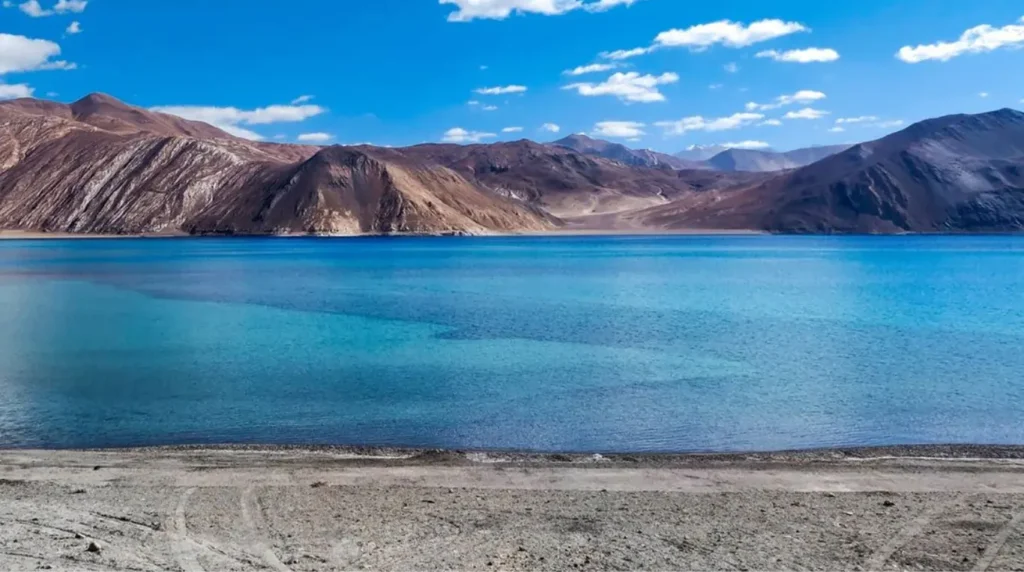
The road trip from Manali to Leh is one of the most dramatic drives on Earth. This journey takes you across massive mountain passes higher than 5,000 meters and leads to legendary spots like the blue waters of Pangong Lake and the sand dunes of Nubra Valley. In this Ladakh Road Trip Guide you will understand everything you need to know about Ladakh road trip.
Why This Road is Different
This isn’t just a drive; it’s an expedition. It isn’t “great” like a smooth highway in the city. It is great because:
- The Landscape: You enter a world that looks more like the Moon than Earth, stark, colorful, and vast.
- The Altitude: You will spend days far above the clouds, where the thin air reminds you that you’ve left the “normal” world behind.
- The Achievement: The effort of crossing five giant mountain passes is exactly what makes reaching Leh feel so rewarding.
The 2026 Reality Check
The highway covers 427 kilometers (via the Atal Tunnel) through some of the most remote parts of Asia. Here is what you need to know before you start:
- Fuel: Petrol stations can be over 320 kilometers apart (the gap between Tandi and Karu). You must carry extra fuel or fill up at every single opportunity.
- Support: The nearest major hospital is in Leh. While the road is manageable for a patient driver, it requires deep respect for the mountain environment.
- Timing: The full journey takes 8 to 10 days to do safely. Attempting to rush this route is the most common mistake travelers make.
The 10-Day “Master” Itinerary (Wishtogo.in Exclusive)
To enjoy this trip without getting altitude sickness (AMS), we recommend this 10-day pace:
- Day 1: Manali to Jispa (via Atal Tunnel). A beautiful start through the world’s longest highway tunnel at this altitude. Stay in Jispa (3,320m) to help your body adjust.
- Day 2: Jispa to Sarchu. Cross the Baralacha La (4,890m). This is a tough day. You’ll sleep at Sarchu in high-altitude tents.
- Day 3: Sarchu to Leh. Cross Lachulung La (5,065m) and the famous Gata Loops (21 hair-raising switchbacks). Arrive in Leh by evening.
- Day 4: Mandatory Rest in Leh. In 2026, the local administration enforces a 48-hour rest period for health safety. Spend this day relaxing at a café and getting your permits.
- Day 5: Leh Local. Visit the Shanti Stupa and Leh Palace.
- Day 6: Leh to Nubra Valley. Cross Khardung La—one of the highest motorable roads in the world. See the double-humped camels at Hunder sand dunes.
- Day 7: Nubra to Pangong Lake. Travel via the Shyok River route. Arrive at the lake that changes color from turquoise to deep blue.
- Day 8: Pangong to Leh. Return to Leh via Chang La (5,360m).
- Day 9: Leh to Sarchu/Jispa. Begin the return journey.
- Day 10: Return to Manali.
Ladakh Trip Costs (2026 Estimates)
For a mid-range trip with WishToGo, expect the following per-person costs:
Permits & Fees: Approximately ₹1,000 for the Inner Line Permit (required for Pangong and Nubra).
Self-Drive (Bikes): ₹35,000 – ₹50,000 (includes rental, fuel, and stays).
Private SUV (shared by 4): ₹25,000 – ₹35,000 per person.
The Window: June to September Only
The Manali-to-Leh highway is closed for about eight months of the year. This isn’t just a rule; it’s geography.
Why the Road Closes
The high mountain passes, like Baralacha La (4,890m) and Taglang La (5,328m), are buried under 15 to 20 feet of snow from October to May. During these months, the road simply doesn’t exist—it’s hidden under a deep white blanket. The passes only open once the Border Roads Organization (BRO) finishes the massive job of carving the road out of the snow, which usually happens by late May or early June.
Choosing Your Month
| Month | What to Expect | Why Choose It? |
| June | The Snow Walls. Huge walls of ice still line the roads. | For Adventure: You get to see the “raw” mountain beauty before the snow melts. |
| July & August | Peak Season. Everything is fully open, but it is very crowded. | For Families: The weather is reliable, all campsites are active, and help is always nearby. |
| September | The Golden Month. Thin crowds, crystal-clear skies, and golden landscapes. | The “Insider’s” Choice: Best for photography and stable road conditions. |
The September Advantage (Editor’s Choice)
Within the travel window, September is the single best month to go. * Clear Skies: Ladakh sits in a “rain shadow,” meaning it gets very little rain. While the rest of India deals with the monsoon, Ladakh has the clearest blue skies of the year.
- Photography: The light quality is outstanding, and the autumn colors begin to turn the valleys golden.
- Less Stress: The massive summer crowds have gone home, prices for campsites drop, and the roads are at their most stable.
The Atal Tunnel Update (2026)
In the past, the Rohtang Pass was the biggest “bottleneck” that delayed the trip. However, since the Atal Tunnel opened, you can now bypass Rohtang entirely. This saves you 4 hours of driving and means you can reach the high-altitude town of Jispa much faster and more comfortably.
Important Note: Even though the tunnel makes the start of the trip easier, the high passes further ahead (like Baralacha La) still dictate when the full road to Leh opens. Never plan a full road trip before June 1st without checking the latest BRO updates!
Also Read: Best Time to Visit India: Month-by-Month Guide for Every Region 2026
The 10-Day Itinerary
| Day | Route | Main Experiences | Altitude |
| 1 | Delhi → Manali (overnight bus) | Leave Delhi in the evening from ISBT Kashmere Gate | 216m |
| 2 | Arrive Manali, Rest Day | Acclimatise, walk in Old Manali, visit Vashisht hot springs | 2,050m |
| 3 | Manali → Jispa | Drive through Rohtang Pass (3,978m), then on to Jispa river camp | 3,220m |
| 4 | Jispa → Sarchu | Cross Baralacha La pass (4,890m), arrive at Sarchu camp | 4,253m |
| 5 | Sarchu → Leh | Cross Tanglang La (5,328m, 2nd highest motorable pass in India), arrive Leh | 3,524m |
| 6 | Leh, Full Rest Day | This rest day is essential, visit Leh Palace, Shanti Stupa, local market | 3,524m |
| 7 | Leh → Nubra Valley | Drive over Khardung La (5,359m), see sand dunes and Bactrian camels at Hunder | 3,048m |
| 8 | Nubra → Pangong Lake | Drive via Shyok River valley, arrive Pangong, watch sunset on the lake | 4,350m |
| 9 | Pangong → Leh | Wake up for sunrise on the lake, drive back to Leh via Chang La pass | 3,524m |
| 10 | Leh → Delhi (fly) | Morning free in Leh, afternoon fly to Delhi (1 hour) | 216m |
The rest day in Leh on Day 6 is not optional. It is medically important. Your body needs time to adjust to 3,524 metres before you go higher. People who skip this day are much more likely to get altitude sickness at Nubra or Pangong. Rest, drink water, and take it slowly.
Altitude Sickness: What You Need to Know
This is the most important page in this guide. Altitude sickness, also called Acute Mountain Sickness (AMS), is the #1 reason Ladakh trips go wrong. It often catches people by surprise because you might feel completely fine for the first few hours, and then suddenly feel very sick.
Why It Happens
As you climb higher, the air becomes “thinner,” meaning there is less oxygen in every breath. Your body is amazing and can adjust by making more red blood cells to carry oxygen, but this takes time. If you move uphill too fast, your body “panics” because it can’t keep up, leading to AMS.
The 2026 Mandatory “48-Hour Rule”
In 2026, the Leh District Administration enforces a mandatory 48-hour acclimatization period.
- The Rule: You cannot apply for your travel permits (the Environmental Development Fee) until you have been in Leh for 48 hours.
- The Logic: This rule was created because too many people were rushing to high passes and getting dangerously sick. You must spend your first two days resting in Leh before heading to Pangong Lake or Nubra Valley.
Spotting the Signs (Symptoms)
Think of AMS like a very bad hangover. Watch out for:
- Mild: Headache, feeling dizzy, nausea (feeling like you might throw up), and loss of appetite.
- Serious: Confusion, difficulty walking in a straight line, or a “wet” cough.
The Golden Rule: If you have symptoms, STOP. Do not go any higher. Rest where you are. If symptoms get worse, descend immediately. Going down to a lower altitude is the only “cure” for serious altitude sickness.
How to Stay Safe
Medicine: Many travelers take Diamox to help their bodies adjust faster. Important: Speak to your doctor before your trip to get a prescription and check for allergies.
Hydrate: Drink 3 to 4 liters of water every day. Dehydration makes AMS much worse.
Avoid Alcohol & Smoking: Stay away from these for at least the first 48 hours. They slow down your body’s ability to adjust.
Eat Light: High-protein and heavy oily foods are hard to digest at high altitudes. Stick to soups, rice, and garlic-based dishes.
Oxygen Levels: In 2026, most hotels in Leh provide Pulse Oximeters. Check your oxygen (SpO2) levels. If they are below 80%, seek medical help at the SNM Hospital in Leh immediately.
The Road from Manali to Leh
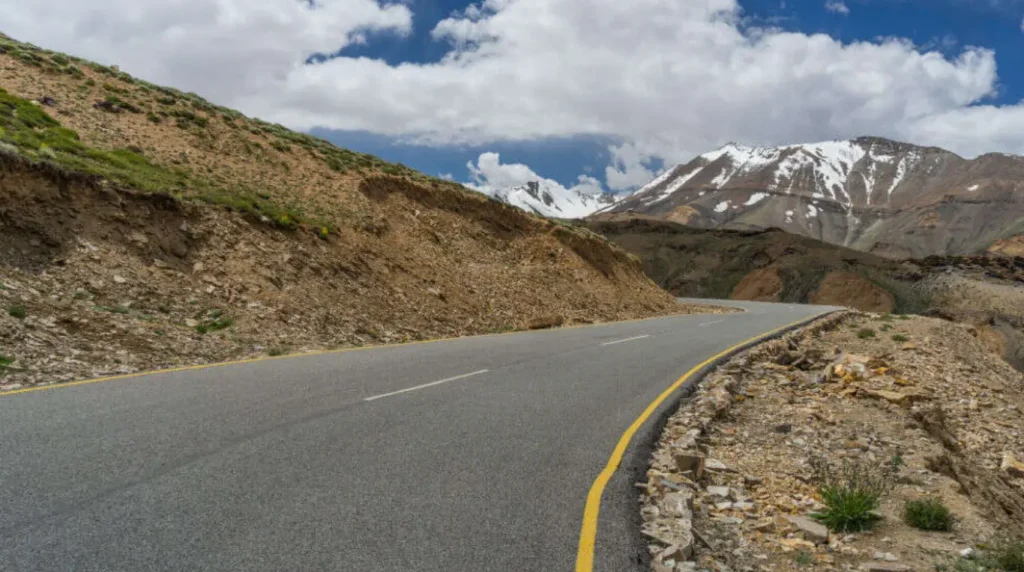
The drive from Manali to Leh usually takes two days, with an overnight stop at Jispa. This isn’t just a commute; it’s an ascent into another world.
Day 1: Manali to Jispa (The Gateway)
- Distance: Approx. 100 kilometers.
- The Big Change: In the past, travelers had to spend 4–6 hours climbing the muddy Rohtang Pass. Today, we use the Atal Tunnel. This 9-kilometer marvel cuts through the mountain, taking you from the green forests of Manali to the dry, brown mountains of the Lahaul Valley in just 15 minutes!
- The Destination: You’ll reach Jispa by afternoon. It is a beautiful riverside village at 3,320 meters. This is the perfect height to sleep and let your body start getting used to the thin air.
Day 2: Jispa to Leh (The High Passes)
This is a long day (10–12 hours) and one of the most incredible drives of your life.
- Baralacha La (4,890m): Your first major pass. Even in summer, you’ll often see massive walls of snow on either side of the road.
- The Gata Loops: A series of 21 dizzying hairpin bends that climb steeply up the mountainside.
- Moore Plains: After the climb, the world suddenly flattens out. You’ll drive across a massive, high-altitude plateau at 4,500 meters that looks like a giant yellow carpet stretched between the mountains.
- Tanglang La (5,328m): The final challenge. This is the second-highest motorable pass in the world! From the top, you’ll descend into the Indus Valley and see the city of Leh appearing in the distance.
Choosing Your Ride (2026 Advice)
Motorcycles: The Royal Enfield Himalayan is the king of this road. It’s built for this terrain and is the favorite choice for solo adventurers and small groups.
The SUV: This is the most comfortable choice. A sturdy SUV like a Mahindra Scorpio or Toyota Innova with an experienced local driver is highly recommended.
The Cost: For a private SUV on the Manali–Leh–Nubra–Pangong circuit, expect to pay between ₹18,000 and ₹25,000 for the drop. (Prices have increased slightly due to 2026 fuel rates and demand).
Nubra Valley – Camels in the Desert at 3,000 Metres
The drive from Leh to Nubra Valley is a journey of extremes. You climb nearly 1,800 meters from the city to the snowy summit of Khardung La, where you’ll find fluttering prayer flags, brave Indian Army soldiers, and a view that stretches across the entire Indus Valley.
The Surreal Landscape
Once you descend into Nubra, the scenery changes completely.
- The Valley Floor: Sitting at 3,100 meters, Nubra is warmer and greener than Leh. You’ll see lush willow trees and wild rose bushes lining the river.
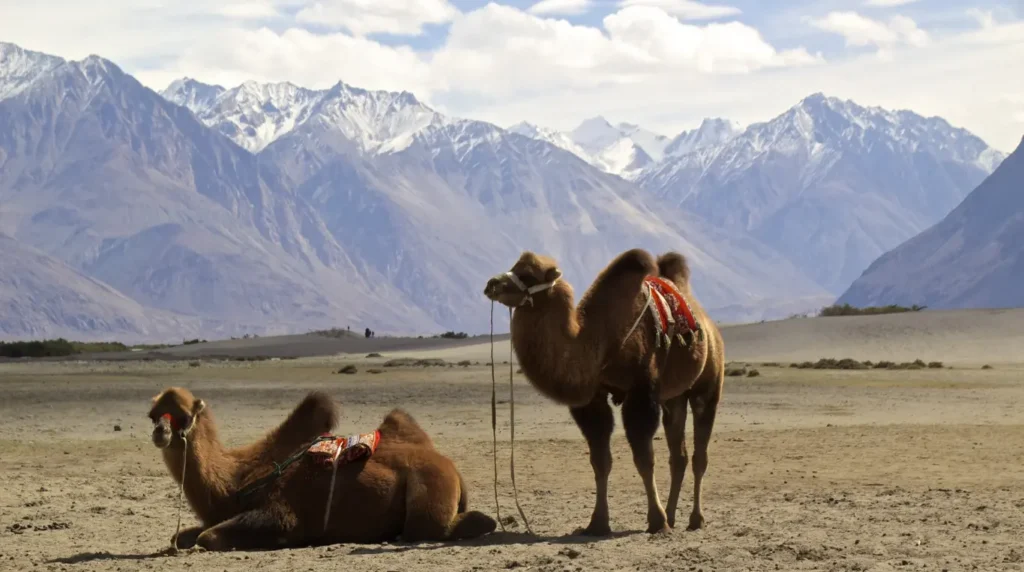
- The Dunes & The Peaks: In a strange twist of nature, the valley features massive, wind-sculpted sand dunes at Hunder. Rising directly behind these dunes are the Karakoram Mountains, with snow-capped peaks reaching over 7,000 meters.
- The Silk Road Legacy: You can ride double-humped Bactrian camels here—descendants of the animals that once carried silk and spices across Asia. A 15–20 minute ride across the dunes costs approximately ₹300 to ₹500 per person.
Spiritual Heights: Diskit Monastery
High above the valley floor sits Diskit Monastery, the oldest and largest in Nubra.
- The Statue: It is famous for the magnificent 32-meter (106-foot) Maitreya Buddha statue. It faces down the Shyok River and is said to protect the valley.
- The Experience: The monastery dates back to the 14th century. Exploring its ancient halls offers a peaceful break from the adventure of the road.
2026 Permit Update (Important for wishtogo.in)
In 2026, the old “Inner Line Permit” (ILP) paper system for Indian tourists has been replaced by a more modern system.
The 48-Hour Rule: Remember, the system will only allow you to generate this receipt after you have spent 48 hours in Leh to ensure you are safe from altitude sickness.
Environmental Development Fee (EDF): You no longer need a separate “permit” for Nubra. Instead, you must pay the Environmental Fee online at lahdclehpermit.in.
The Cost: Expect to pay a one-time fee of ₹400 (Environment Fee) + ₹20 per day (Wildlife Fee).
Also Read: Himachal Pradesh Travel Guide: The Mountains Made Simple
Pangong Lake – The Blue That Photographs Cannot Capture
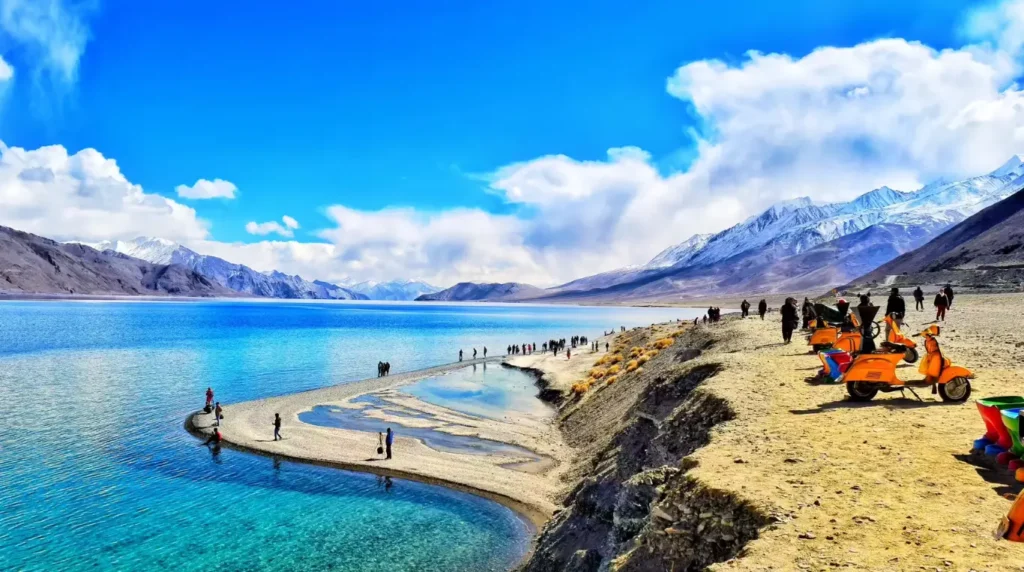
If you’ve seen photos of Pangong Lake and thought they were fake or edited, you aren’t alone. But the truth is: the water really is that color.
A Natural Masterpiece
Pangong is a high-altitude “saltwater” lake that sits at 4,350 meters above sea level. It is 134 kilometers long, with about 60% of it stretching into China.
- The Colors: Depending on the time of day and the angle of the sun, the water shifts from bright turquoise near the shore to a deep, electric cobalt blue in the center.
- The Reflection: Because the air is so clear and thin, the brown, snow-capped mountains on either side are reflected perfectly on the surface when the water is still.
- The “First Sight” Moment: As you drive around the final bend in the road, the lake suddenly appears below you—a massive splash of blue in a brown mountain desert. It is a moment where everyone stops the car just to stare.
Getting There (The 2026 Route)
- The Drive: Most travelers now take the Shyok Valley Road if coming from Nubra Valley. This saves you from going all the way back to Leh and takes about 5–6 hours.
- The High Pass: If you are coming directly from Leh, you will cross Chang La (5,360m), the third-highest motorable pass in the world.
- Stay the Night: Do not just visit for an hour and leave. The magic happens at sunrise. Watching the light hit the mountain peaks first, then slowly “turning on” the blue of the lake, is an experience you will never forget.
2026 Permits & Planning (Wishtogo.in Essentials)
The rules for visiting Pangong have become very strict to protect the environment.
Booking: Campsites in Spangmik and Lukung fill up 3 to 4 months in advance for the peak months of July and August.
Indian Tourists: You need to pay the Environmental Development Fee (EDF) online at lahdclehpermit.in. Just like Nubra, you can only do this after your mandatory 48-hour rest in Leh.
Foreign Visitors: You require a Protected Area Permit (PAP). This must be arranged through a registered travel agent in Leh (like WishToGo) and requires a group of at least two people.
What the Permits Are and How to Get Them
Ladakh sits near sensitive international borders, so the government uses a system to track visitors heading to places like Pangong Lake, Nubra Valley, Tso Moriri, and Hanle.
For Indian Citizens: The Environmental Development Fee (EDF)
The term “Inner Line Permit” (ILP) is now a thing of the past for Indians. It has been replaced by a mandatory fee system.
- The Process: Instead of a permit, you simply register online at lahdclehpermit.in.
- The Cost:
- Environment Fee: ₹400 (One-time fee).
- Wildlife Fee: ₹20 per day (For the number of days you spend in protected zones).
- Red Cross Fund: ₹50 (Optional donation).
- The “48-Hour Lock”: This is critical. The online portal will not allow you to generate your receipt until 48 hours after your arrival in Leh. This system-enforced rule ensures every traveler has rested enough to avoid altitude sickness.
For Foreign Nationals: The Protected Area Permit (PAP)
Foreign travelers still require a formal Protected Area Permit (PAP) to visit restricted zones.
- The Rule of Two: By law, foreign nationals must travel in a group of at least two people to obtain a PAP. Solo travelers usually join up with others through a travel agent.
- The Process: Unlike the domestic fee, the PAP must be applied for through a registered travel agent in Leh (like WishToGo). You will need to provide copies of your passport and valid Indian visa.
- The Cost: Approximately ₹600 to ₹800 per person, which includes the government fees and a small agent processing charge. It usually takes one working day to issue.
Pro Tips for All Travelers
Leh Local: You do not need any permits or fees to visit Leh town, local monasteries (like Thiksey or Hemis), or the “Sangam” (confluence of Indus and Zanskar).
Keep Physical Copies: Do not rely on your phone! Mobile network is non-existent at many high-altitude checkpoints. Carry 4 to 5 printed copies of your EDF receipt or PAP.
Checkpoints: You will be stopped at places like South Pullu (on the way to Nubra) and Durbuk (on the way to Pangong). Officers will collect one of your physical copies at each stop.
Frequently Asked Questions: Ladakh Road Trip Guide
Can I do the Ladakh road trip without a guide?
Yes. Many travelers complete the route independently by hiring a private vehicle and driver. You don’t need a “tour guide” to walk you through the mountains, but you do need:
- A Professional Driver: Hiring a local driver from Manali or Leh is the smartest move. They know exactly where the hidden potholes are, where the last reliable fuel station is, and how to handle the high-altitude passes.
- Altitude Knowledge: You must be your own guide when it comes to health. Knowing when to rest and drink water is more important than knowing the road.
How much does the Ladakh road trip cost?
For two people traveling in a mid-range style (comfortable camps and private SUVs), a 10-day trip from Manali typically costs:
- Total Circuit Cost: ₹50,000 to ₹80,000 per person. This includes your SUV with a driver, all meals, stays, and permits.
- The Leh-to-Delhi Flight: This usually costs between ₹5,000 and ₹12,000.
- Pro Tip: In 2026, flight prices for July and August spike early. Book your return flight at least 3 to 4 months in advance to save thousands.
What should I pack?
The temperature in Ladakh is a “rollercoaster.” You might be in a T-shirt at noon in Leh and needing a heavy jacket by midnight at Pangong Lake.
- The Layers: Pack thermal base layers, a thick fleece, and a windproof down jacket.
- Sun Protection: At 4,000+ meters, the sun is incredibly strong. You will burn much faster than at the beach. Pack SPF 50+ sunscreen, SPF lip balm, and high-quality sunglasses.
- The “Mountain Pharmacy”: Bring Diamox (after consulting your doctor), oral rehydration salts (ORS), and basic pain relievers for altitude headaches.
- Tech Tip: Cold air kills phone batteries! Carry a high-capacity power bank and keep your phone in an inside pocket close to your body heat.
Is Pangong Lake really worth the long drive?
Yes, without a doubt. Pangong Lake is one of the few places on Earth that actually looks better in person than in photos. The sheer scale of the water, the silence of the mountains, and the feeling of standing at 4,350 meters is something a screen simply cannot capture. Most travelers describe the first moment they see the lake as the highlight of their entire lives.
Plan Your Ladakh Expedition with WishToGo
Whether you want a classic 10-day Manali-to-Leh circuit or an epic 15-day journey including the Zanskar Valley and the lush Srinagar route, WishToGo handles all the heavy lifting.
- Verified SUV Drivers with years of mountain experience.
- 2026 Permit Processing (EDF/PAP) included in every package.
- Curated Stays in the best riverside camps and heritage guesthouses.
Ready to hit the road? Send your travel dates to hello@wishtogo.in. We’ll reply with a custom itinerary and a clear, honest cost breakdown within 24 hours.