
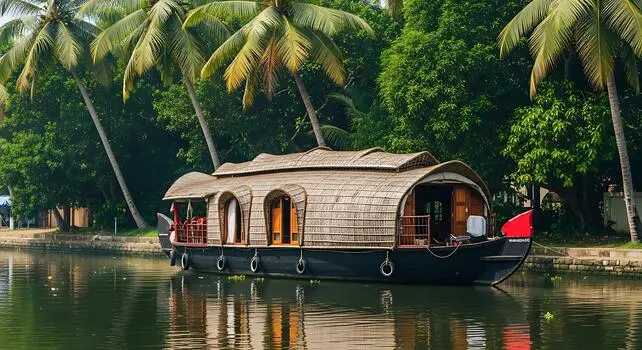
A Kerala backwaters houseboat experience typically includes cruising through palm-lined canals, enjoying local Kerala meals onboard, watching sunset on Vembanad Lake, and spending a peaceful night anchored on the water. Alleppey is the best starting point for most travelers, and the ideal time to visit is from October to February.
There’s a moment that happens on almost every Kerala houseboat trip.
You’ve been on the water for an hour or two. The canal has narrowed to the point where the coconut palms meet overhead. The engine is at low speed, barely audible. And then, for a few seconds all the sounds of ordinary life disappear completely.
No traffic. No city noise. Nothing but the water and the trees and the occasional call of a kingfisher.
That moment is why people call the Kerala backwaters one of the great travel experiences in Asia. Not hyperbole. Just the honest memory of a specific kind of quiet that’s increasingly hard to find.
The backwaters are a 1,900-kilometre network of interconnected lakes, rivers, canals, and lagoons running parallel to Kerala’s coast the result of centuries of irrigation work and geological history. The houseboat that takes you through them is a direct descendant of the traditional cargo vessels that moved rice and spices through these same waterways for generations. The craft is fundamentally unchanged: bamboo frame, coir matting, local timber, assembled without nails.
This guide explains what actually happens hour by hour, decision by decision so that when you plan your backwater trip, you’re making informed choices rather than guessing from photographs.
Alleppey or Kumarakom: The Choice That Shapes Everything
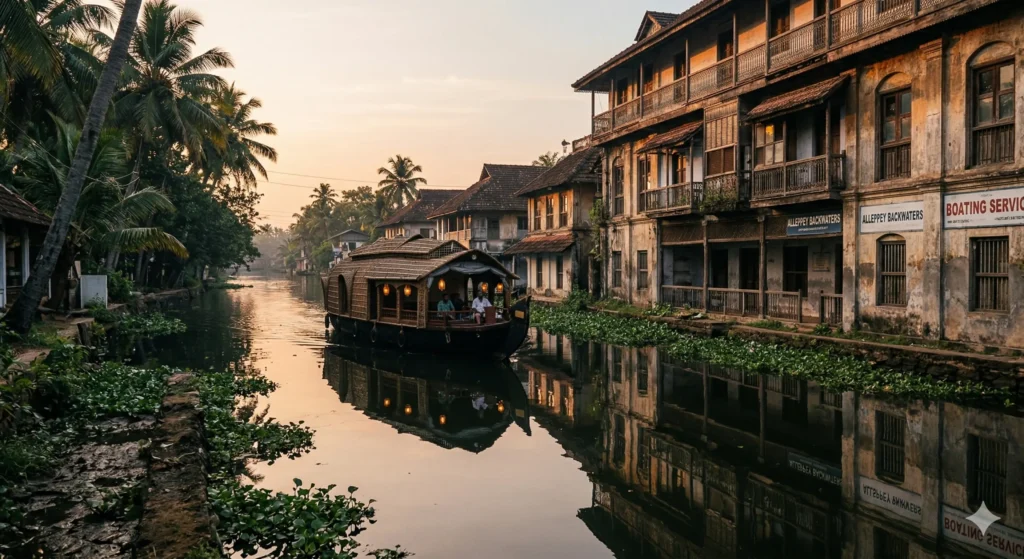
These are the two main bases for Kerala backwater tourism. They’re 53 kilometres apart, on either side of Vembanad Lake. And they offer genuinely different experiences.
Alleppey officially Alappuzha, though almost no one calls it that is where most visitors should start.
The town has grown around its canal network, and the houseboat industry here has real depth: over 1,200 registered boats across every price category, good access to the narrow village canals where the most intimate backwater experience happens, and direct connection to Vembanad Lake for open-water sailing at sunset. The town itself has character Portuguese buildings from the 17th century, the busiest rice-boat jetty in Kerala, and the Nehru Trophy Boat Race ground that fills with snake boats and 150,000 spectators every August.
Alleppey is right for first-time visitors, anyone on a budget, and people who want the full backwater experience including the village canal network.
Kumarakom is different.
It sits on the eastern shore of Vembanad Lake quieter, more upscale, fewer boats. The Kumarakom Bird Sanctuary directly on the lake edge attracts Siberian storks, painted storks, and herons in the October-to-February window with genuine consistency. The luxury resorts here Taj Kumarakom, Coconut Lagoon by CGH Earth, Kumarakom Lake Resort are among the finest properties in Kerala.
Kumarakom is right for return visitors, luxury travelers, and serious birdwatchers.
The practical version: Alleppey if it’s your first time and you want to understand what the backwaters actually are. Kumarakom if you’ve been before and want to slow down, watch birds, and stay somewhere genuinely beautiful.
Choosing a Houseboat: What the Options Actually Mean
The houseboat market in Alleppey has boats at every price point. Here’s what each category actually delivers, not just the brochure version.
| Type | Price per Night | Best For | What to Expect |
| Standard – No AC | ₹6,000–9,000 | Budget travellers, Oct–Feb visits | Clean and functional. Perfectly comfortable in winter. Warm at night Apr–Oct. |
| Standard – With AC | ₹10,000–16,000 | First-timers, couples year-round | The baseline recommendation for most visitors. Comfortable any month. |
| Premium – 2BR, AC | ₹18,000–32,000 | Families, groups of 4 | More space, better finish, private sundeck at the front. |
| Luxury / Duet Boat | ₹30,000–65,000 | Honeymooners, special occasions | Private chef, premium finish, panoramic lake views. Sometimes a jacuzzi. |
| Shikara (day boat) | ₹1,500–3,500/hour | Day visitors, photography | Small open wooden boat accesses narrow canals the houseboat can’t reach. |
A few things the table doesn’t tell you.
The non-AC boat is perfectly fine from November to February, when Kerala’s nights settle between 20 and 22 degrees. The river breeze through open windows keeps the cabin comfortable, and there’s something honest about sleeping without the hum of air conditioning in a traditional wooden vessel on a centuries-old waterway. From April through September, however, the non-AC boat is genuinely warm at night, not impossible, but uncomfortable for most travelers. If you’re visiting outside the November-to-February window, the AC boat is worth the extra few thousand rupees.
The jump from standard to premium is mostly about space and finish rather than a fundamentally different experience. Premium boats have a better-quality fit-out, a forward sundeck that gives you a clear view ahead (versus watching the world pass from the sides), and usually a better-equipped kitchen. Whether that’s worth ₹7,000 to 16,000 more per night depends on your priorities.\
The Question That Matters More Than Any of This
Before price, before boat category, before anything else, ask the operator one question:
Where does the boat anchor overnight?
The DTPC regulation requires all boats to stop by 5:30 to 6pm and stay anchored until morning. Some operators anchor at crowded jetties, close together, with generators running and other boats alongside. Others anchor in open positions on Vembanad Lake, a kilometre from the nearest bank, nothing between you and the stars.
The difference in experience between these two situations is not small.
If the answer to your question is vague, treat that as information.
What Actually Happens on a Houseboat Day
The houseboat day has a rhythm. Understanding it in advance helps you appreciate what’s happening rather than wondering what comes next.
Check-In: Around Noon
Most Alleppey houseboats depart between 12pm and 1pm from the Finishing Point jetty or from smaller operator jetties. The crew shows you the cabin, the captain explains the safety basics, and within 20 minutes you’re moving. The transition from the noise of the jetty to the quiet of the first canal happens fast, faster than you expect.
Afternoon: Village Canals (1pm to 5pm)
This is the heart of the experience.
The boat moves through a sequence of canals that get progressively narrower as the afternoon continues, from the main arterial waterways near Alleppey into the village network of Kuttanad, where the channels are barely wide enough for the houseboat. On some stretches the captain uses a bamboo pole instead of the engine. The palms close overhead.
The life on the banks doesn’t perform for the boat. It just continues.
Women fill water pots at stone ghats that have been there for generations. Men fish from dugout canoes with nets they’ve repaired themselves. Children wave with the genuine enthusiasm of people who haven’t yet learned that boats on the canal are ordinary. Toddy tappers climb coconut palms in two fluid movements with nothing between them and the ground but a rope.
Lunch is served on board around 1:30pm. The karimeen pollichathu, pearl spot fish (found only in Kerala’s backwaters, impossible to replicate elsewhere because it doesn’t survive freezing) wrapped in banana leaf with spices and grilled, is the defining dish of the ecosystem. It’s served with Kerala rice, avial (a coconut and yoghurt vegetable preparation that’s considerably more interesting than it sounds), a prawn curry if requested, and pappadom. The cook prepares all of this on a small gas stove in a galley the size of a large wardrobe, and the results are consistently better than most restaurant food.
Sunset on the Lake (5pm to 6pm)
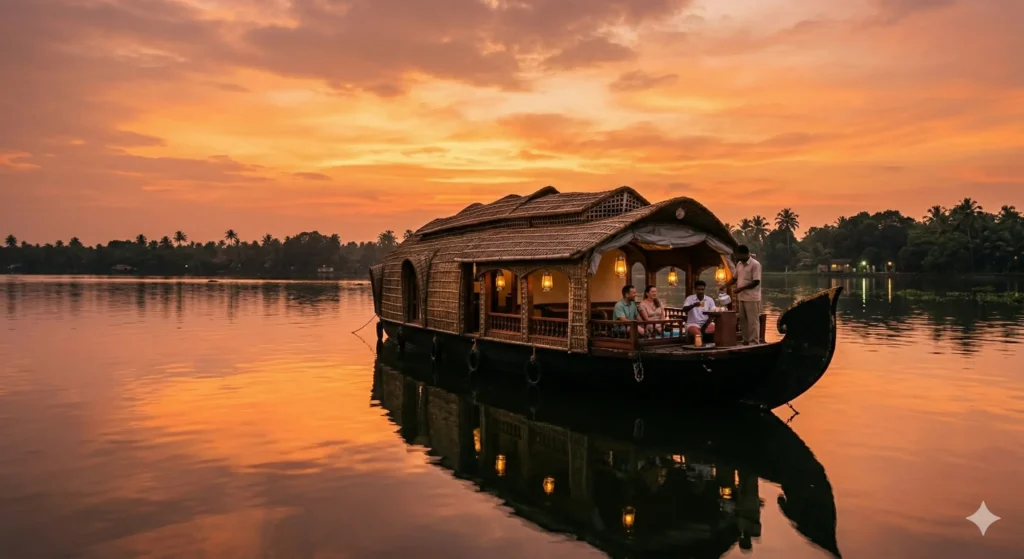
As the afternoon tips into evening, most boats make their way to the open expanse of Vembanad Lake.
The transition from narrow canal to open water is one of the genuine surprises of the trip. The palm canopy opens up all at once and suddenly you’re on what feels like an inland sea — 96 kilometres long, wide enough that in some directions you can’t see the bank.
The sun sets behind the coastal strip to the west. The colour sequence, gold to amber to deep orange, happens over 45 minutes, and the lake reflects it exactly. This is the moment most people photograph and most photographs fail to adequately represent. The scale, the silence, and the fact that you’re on the water rather than watching from the shore produces something that’s harder to translate into an image than almost anything else on this trip.
Anchored for the Night
The boat stops by 6pm. If you’ve chosen a good operator, you’re anchored on open water, the nearest bank a kilometre away in the darkness, the generators quiet, the sky as dark as it gets in Kerala.
Dinner is served on deck. Another fish preparation, a dal, rice, appam with coconut milk stew if you asked for it. The crew eats separately near the stern.
The evening on a houseboat is its own category of experience, hard to prepare for and harder to describe. The sounds change after 8pm: the distant call of a fishing owl, something large moving in the lake, the low sound of water against the hull. Some people read. Some people sit on deck and watch the darkness, which is more rewarding than it sounds.
Morning: Checkout by 9:30am
The boat moves again at first light, returning through the canals toward Alleppey. Morning on the backwaters has a different quality from afternoon, the mist sits on the warm water in the cooler air, the light arrives horizontally and turns everything gold, and the village activity on the banks begins again from the beginning. Breakfast on board, checkout at the jetty between 9 and 9:30am.
The Shikara: For When You Want to Go Deeper
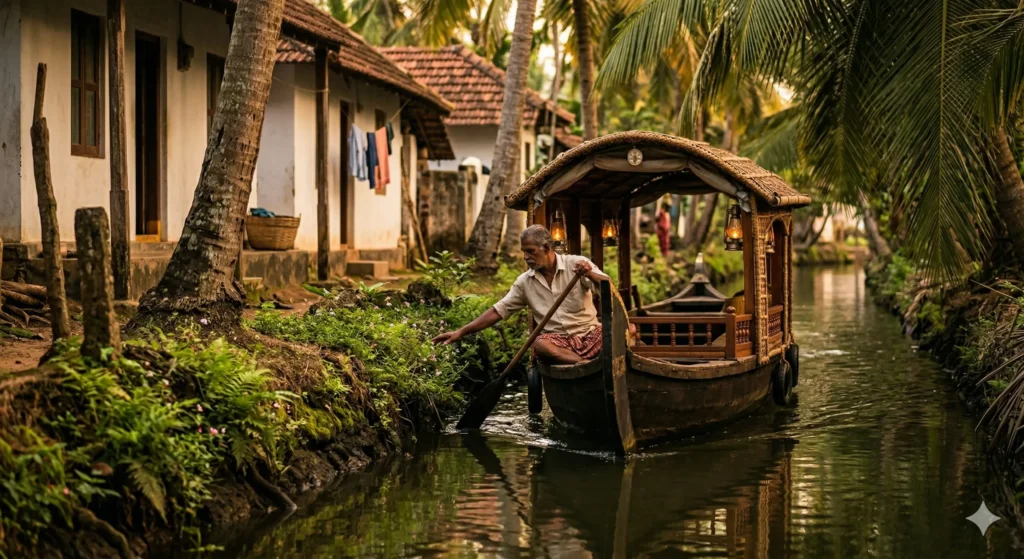
The houseboat can’t get into the narrowest village canals. It’s too wide.
The shikara can.
A small, open wooden boat, manually paddled or with a small motor, the shikara takes you into the parts of the backwater system that the houseboat passes by: the coir-weaving cooperatives, the toddy shops accessible only by water, the Kuttanad paddy fields farmed below sea level, the village temples with their own small ghats.
A 3-hour shikara tour from Alleppey costs ₹1,500 to ₹2,500 (book through the DTPC tourist information centre for a fixed government rate). The smaller boat and slower pace mean the villages engage with you rather than watching you pass. A good guide takes you away from the popular routes and into the canal network that most houseboat passengers never see.
The shikara also works well as a standalone experience if an overnight houseboat is outside your budget or schedule. Alleppey’s own canal network is accessible without leaving the town, and an evening shikara ride at dusk is a genuine experience rather than a consolation prize.
The Kollam-Alleppey Day Cruise
The Kerala State Water Transport Department runs a daily ferry between Kollam and Alleppey, an 8-hour journey covering 80 kilometres of the main backwater route. It departs at 10:30am and arrives at 6:30pm. The government ferry costs about ₹400 per person.
This is a completely different experience from the houseboat. Not luxurious, wooden seats, basic food from the pantry. But the scale of the journey through the Kuttanad landscape, the lake crossings, the stops at small jetties where vendors board with coconut water and banana chips, and the way it connects two entirely different backwater characters gives a broader understanding of what the system actually is.
Local ferry passengers outnumber tourists on most departures. The stops are not curated for visitors. You’re on a working waterway, moving at a working pace.
If you’re traveling between Kollam and Alleppey anyway, it’s the obvious choice. If you have a free day and want to understand the backwaters at the largest scale, it’s worth doing for its own sake.
The Best Time to Visit the Backwaters
October through February delivers the experience the photographs promise, calm water, clear light, comfortable temperatures, everything fully operational.
November and December are the peak months, and they earn it. The post-monsoon light in November has a quality that November rarely has anywhere else. December’s blue skies and cool evenings are as close to perfect as South India gets.
The question of the monsoon (June to September) comes up often.
Here’s the honest answer.
The backwaters are higher and more dramatic during the rains, with the lake swelling and the canals running fast. It rains, sometimes heavily. The houseboat experience is more intense and less beautiful, more closed-up, more atmospheric in a different way. If your purpose is an Ayurveda retreat (the monsoon months are the traditional therapeutic window, when the humidity opens the body to treatment), then the backwaters in monsoon make sense as context. For the standard houseboat experience, November to February is clearly better.
March, April, and early May are a reasonable middle ground. The monsoon is months away, crowds have thinned from the December–January peak, and prices are 20 to 30 percent below peak. Slightly warmer evenings, same canals, same food, same lake.
What the Food Is Like – Because It Really Matters
Most backwater guides treat food as a bullet point. It shouldn’t be. The houseboat meal is one of the defining experiences of Kerala travel, and the difference between a cook who knows what they’re doing and one who doesn’t is significant.
The benchmark dish is the karimeen pollichathu.
Pearl spot fish (karimeen in Malayalam) lives only in Kerala’s backwaters. It can’t be frozen and maintain its texture, which means the fish you eat on the boat was in the lake two hours before. The preparation, marinated with red chilli, turmeric, and tamarind, wrapped tight in banana leaf, grilled until the leaf chars, is simultaneously simple and completely specific to this ecosystem. If your houseboat serves this well, the rest of the meal will probably be good too.
The avial is the other dish to pay attention to: a mixed vegetable preparation in fresh coconut and yoghurt with a tempering of coconut oil and curry leaves that has a delicacy and balance most outsiders don’t expect. Kerala’s vegetarian cooking is genuinely excellent.
One practical note on alcohol: most DTPC-registered houseboats don’t permit it on board. Kerala’s Abkari Act requires a special permit for boats to serve alcohol, and most smaller operators don’t hold one. Some premium operators do. If a drink with your sunset matters, ask specifically when booking whether the boat holds the permit.
How to Book – And What to Watch Out For
There are three ways to book a houseboat, and each has trade-offs.
Booking through a tour operator like WishToGo gives the highest reliability, we’ve used the same operators for years, we know which boats anchor on the lake rather than at the jetty, and we’ve eaten the food.
Booking through certified platforms (Kerala Houseboat Club, DTPC Alleppey directly) is the reliable self-booking option. Check the DTPC certification specifically, it requires safety inspections and operator registration.
Booking from touts at the jetty is the one to avoid. Prices are often higher than they appear, and the ‘premium lake-view overnight’ they describe may turn out to be a crowded jetty position.
Three questions to ask before confirming any booking:
One: Where exactly does the boat anchor overnight? (You want ‘open lake,’ not ‘at the jetty.’)
Two: Is the boat DTPC-certified? (Yes or no, no hedging.)
Three: What is the cook’s specialty dish? (If they can’t answer this, food will be an afterthought.)
Those three answers tell you most of what you need to know.
Beyond the Houseboat: What Else the Backwaters Offer
The Nehru Trophy Boat Race
Every year on the second Saturday of August, Punnamada Lake near Alleppey hosts the Nehru Trophy Boat Race. Thirty-foot snake boats, chundan vallam, each rowed by more than a hundred oarsmen in precise synchronisation, race across the lake with a speed and noise that’s entirely different from what ‘boat race’ might suggest. Up to 150,000 spectators line the banks. If you’re in Kerala in August and can be flexible, this is worth adjusting an entire itinerary around.
Birdwatching on Vembanad Lake
Kumarakom Bird Sanctuary gets the most attention, but the Vembanad Lake ecosystem as a whole attracts remarkable migratory bird populations from October to February. Little cormorants, purple herons, painted storks, Indian darters, and in good years, Siberian cranes. The Pathiramanal Island in the middle of Vembanad, accessible by boat, essentially uninhabited, no facilities, is the best birdwatching point on the lake and almost entirely unknown outside serious birder circles.
The Kuttanad Paddy Fields
The Kuttanad region between Alleppey and Changanacherry is one of the world’s few places where farming happens below sea level. The paddy fields are separated from the surrounding backwaters by earthen bunds maintained by cooperatives, one to two metres below the waterline. During harvest season (January–February and August–September), the agricultural activity is vivid from the water. WishToGo’s village tour packages include guided farm visits by shikara.
Frequently Asked Questions about Kerala backwaters houseboat
Is one night enough on a houseboat?
For most people, yes.
The standard checkout time of 9 to 9:30am means you get about 21 hours on the water, enough for the full afternoon canal cruise, the sunset on the lake, the overnight experience, and the morning light. That’s enough to understand what the backwaters are and why they matter.
Two nights allows a slower pace and access to different canal routes on each day, which is better for photography and for people who feel the first day went too quickly. If you’re on a tight schedule, one night done well is the right choice.
What’s the difference between Alleppey and Kumarakom?
Alleppey for the full backwater experience at every price point. Kumarakom for quieter, higher-end travel with excellent birdwatching. Both access Vembanad Lake. The narrow village canal network is better from Alleppey. The luxury resort properties are concentrated in Kumarakom. Most first-time visitors should start in Alleppey.
Can I swim in the backwaters?
Swimming from the houseboat in the main channels or lake isn’t recommended. The water quality in the main arteries varies, and Vembanad Lake has currents that are stronger than they appear. A small population of mugger crocodiles also inhabits the lake, sightings are rare, but they exist.
If you want to swim in Kerala, Cherai Beach on Vypeen Island (accessible by ferry from Fort Kochi) is excellent, long, clean, and backed by the backwaters on one side and the Arabian Sea on the other.
Do I need to tip the crew?
Yes, and it matters.
The captain, cook, and crew are the people who make or break the experience. A tip of ₹500 to ₹1,000 per night, split among the crew, is appropriate and appreciated. Give it directly to the crew in cash at checkout, not through the operator.
What should I bring on board?
Mosquito repellent, important for evenings anchored near canal banks. Sunscreen for the afternoon on deck. A light layer for evenings in November to February (the lake breeze at night can be cooler than expected). A dry bag for your camera in the monsoon season.
Everything else, towels, bedding, water, all meals, is provided by the boat.
Can I take a houseboat with young children?
Yes. Children typically love it.
The boat is stable, so there’s essentially no motion sickness risk. Children interested in birds, fish, boats, and the novelty of sleeping on water have a very good time. The practical concern is the open sides of some boats near the bow, keep young children close on deck. Let the crew know in advance that you’re traveling with children; they’re generally wonderful with them.
Is the houseboat experience worth it?
This is the real question behind all the others.
The honest answer: it’s worth it when it’s done right. When the boat anchors on the open lake overnight. When the cook knows what they’re doing with a karimeen. When the afternoon canal route takes you away from the main tourist arteries and into the actual village network.
It’s not worth it when it isn’t. When you’re one of thirty boats at a crowded jetty with generators running through the night and a fish curry that could have been made in any city restaurant.
The difference between these two outcomes is almost entirely a function of who you book with. Ask the right question, where does the boat anchor overnight, and you’ll know which one you’re getting.
Planning Your Kerala Backwater Trip
The backwaters work best as part of a Kerala circuit rather than in isolation, combined with Fort Kochi’s colonial heritage, Munnar’s tea country, and Thekkady’s wildlife, the houseboat night becomes part of a journey through the full character of South India’s most distinctive state.
WishToGo’s Kerala packages range from 5-day circuits (Fort Kochi, Alleppey houseboat, Munnar) to extended 10-day programmes adding Thekkady, Varkala, and the Andaman Islands. Every package includes a vetted houseboat operator with confirmed open-lake anchoring.