
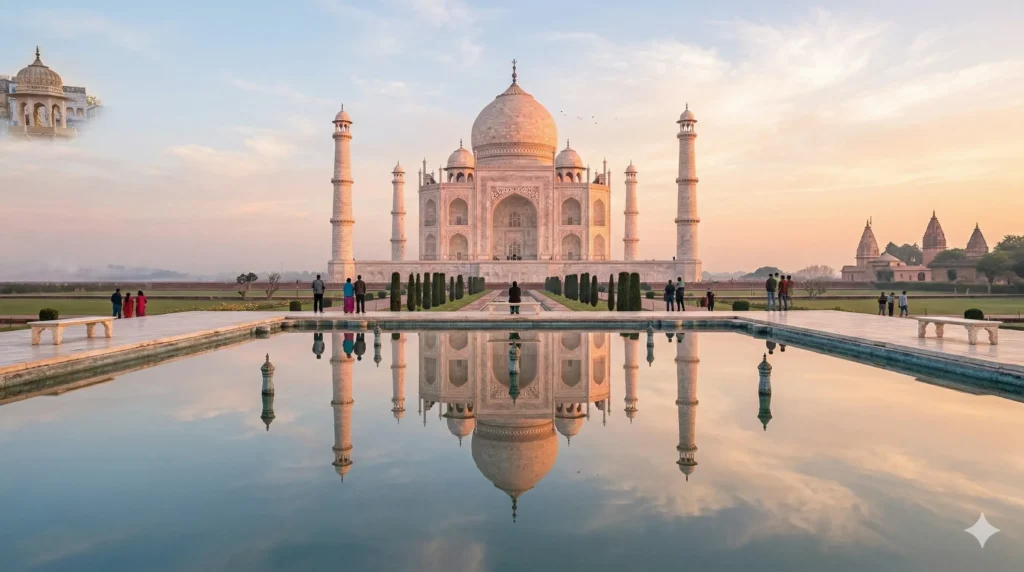
This Taj Mahal visitor guide gives you everything you need to visit the Taj Mahal properly: the tickets, the timings, the story, what’s actually inside, where to stand for the photographs, how to get there, and the one timing decision that makes or breaks the whole experience.
The best way to visit the Taj Mahal is at sunrise, when crowds are low and the marble changes color from soft grey to pink and gold. Entry tickets cost ₹1,100 for foreign visitors, and a visit usually takes 2 to 3 hours including the gardens and main mausoleum.
The Taj Mahal is one of those places that photographs have made simultaneously famous and misunderstood.
You’ve seen thousands of images. You think you know what to expect.
And then you stand in front of it for the first time, and realize that none of the photographs prepared you.
Not for the scale. Not for the perfection of the proportions. Not for the quality of the gemstone inlay work visible at close range. Not for the emotional weight of understanding the story behind it.
The Single Most Important Decision: When You Visit
Most visitors to the Taj Mahal make the same mistake.
They arrive at 10am, 11am, noon, whenever it fits their schedule. The light is harsh, the marble loses the warmth that makes it beautiful, and 15,000 other visitors are doing the same thing.
The Taj Mahal at noon is still extraordinary. But it’s not what it can be.
Here’s the timing reality, laid out plainly:
| Time of Visit | Light Quality | Crowds | Our Rating |
| Pre-dawn to 7:30am (BEST) | Marble shifts from blue-grey to pink-gold, the famous moment | Minimal, sometimes fewer than 200 people | ⭐⭐⭐⭐⭐ – No comparison |
| 7:30am to 10am | Golden morning light, still beautiful | Building steadily | ⭐⭐⭐⭐ – Still excellent |
| 10am to 3pm | Harsh overhead sun, marble loses warmth | Peak, 10,000+ visitors | ⭐⭐ – Not recommended |
| 3pm to 6pm (closing) | Warming afternoon light, marble turns gold again | Declining | ⭐⭐⭐⭐ – Good second option |
| Full moon night (special ticket) | White marble in moonlight, completely different experience | Limited to 400 total / night | ⭐⭐⭐⭐⭐ – Once in a lifetime |
The sunrise visit is not a suggestion. It’s the experience the Taj Mahal was built for.
The gates open 30 minutes before sunrise. Be in position at the central reflecting pool by 6:15am (adjust for the season, sunrise ranges from 5:15am in June to 6:20am in December). At that hour, there are sometimes fewer than 200 people in the entire 42-acre complex. The reflecting pool is undisturbed. The birds are the loudest thing. And the marble does something in that first 90 minutes that no photograph, no matter how good, fully captures.
It shifts. Grey-blue at pre-dawn, turning silver as the light increases, then gold, then the pink-orange of the sunrise hitting Makrana marble, a colour unique to that stone and that light, and then cooling to warm white as the morning progresses. Each phase lasts 10 to 15 minutes and is more beautiful than the last.
If you’re visiting Agra on a tight schedule and can only do the sunrise visit, that’s the right call. If you can stay overnight and visit at sunrise, then again at the late afternoon golden hour, two completely different experiences, same monument, even better.
Tickets: What You Pay and What You Get
| Category | Entry Price | Includes | Note |
| Foreign nationals | ₹1,100 | Garden + mausoleum exterior | Bring passport – checked at gate |
| Indian citizens | ₹50 | Garden + mausoleum exterior | Aadhaar or ID required |
| SAARC / BIMSTEC nations | ₹540 | Garden + mausoleum exterior | Bangladesh, Nepal, Sri Lanka, Bhutan, Maldives, Myanmar, Thailand |
| Inner chamber entry | +₹200 (all visitors) | Entry to tomb room – cenotaphs of Mumtaz and Shah Jahan | Paid separately at the mausoleum plinth |
| Children under 15 | Free | All areas | No ticket needed |
| Full moon night viewing | Separate ticket (limited) | 8pm–midnight, 50 visitors per slot | Book via ASI – sells out immediately on opening |
Book online at asi.payumoney.com – the Archaeological Survey of India’s official portal. Online booking is not mandatory, but the physical ticket counter queue in peak season (December–January) can be 30 to 45 minutes. The online booking takes 5 minutes. Bring a printout or your phone screenshot.
The inner chamber ticket (₹200, paid at the mausoleum plinth) is worth buying. The actual tomb room is where the cenotaphs of Mumtaz Mahal and Shah Jahan are, where the pietra dura inlay work is most concentrated and most detailed, and where the acoustics – a reverberation of almost 28 seconds, produce a sound experience that’s genuinely extraordinary in a marble dome of that proportion.
The Story, Because It Changes How You See the Monument
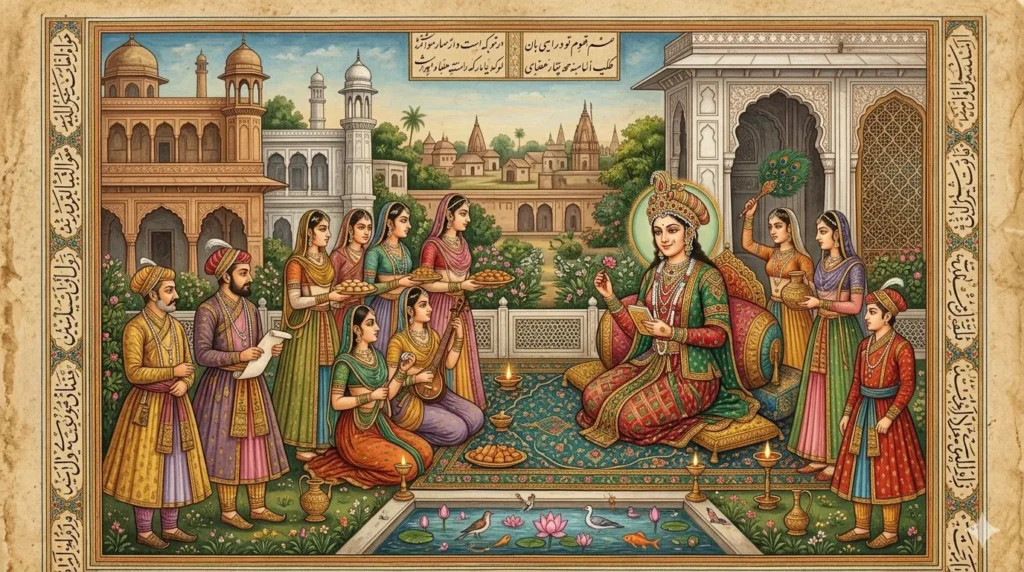
Arjumand Banu Begum, known to history as Mumtaz Mahal, ‘Jewel of the Palace’, was the third and favourite wife of Shah Jahan, who became the Mughal Emperor in 1628.
Their marriage in 1612 was, by every account, a genuine love match. Shah Jahan was devoted exclusively to Mumtaz. He took her on every military campaign. She bore him 14 children. She was his closest political adviser and confidante.
On June 17, 1631, she died in childbirth, delivering their 14th child.
Shah Jahan’s grief was, by contemporary accounts, total. He went into mourning for two years. He emerged with his hair turned white. And he spent the rest of his reign building the monument that became the Taj Mahal.
The project began in 1632. It employed 20,000 craftsmen drawn from across the Mughal Empire and from Persia, Central Asia, and Europe. It was completed in 1653, a 22-year construction, at a cost that in today’s terms would be measured in billions.
Shah Jahan planned to be buried in a mirror Taj of black marble on the opposite bank of the Yamuna. He never built it. His own son Aurangzeb imprisoned him in Agra Fort in 1658, where he spent his last eight years looking across the river at the monument he had built for his wife. He died in 1666. He was buried beside Mumtaz in the crypt below the main chamber.
The only asymmetric element in a structure of perfect symmetry is Shah Jahan’s cenotaph, placed beside Mumtaz’s rather than above it, because he had never intended to be buried here at all.
This is the story you carry with you when you walk through the gate.
What to See Inside the Complex
The Great Gate (Darwaza-i-Rauza)
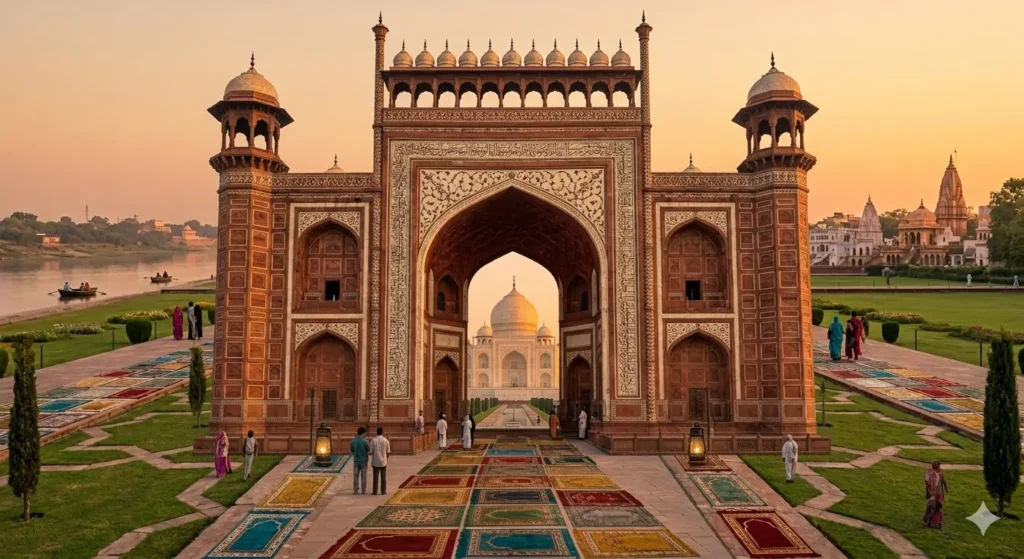
The gateway through which you enter the main complex is itself a masterpiece, 30 metres of red sandstone and white marble, with Quranic calligraphy framing the central arch.
It’s designed deliberately to conceal the Taj Mahal until the last moment.
You approach, see only the gate. You pass through the central arch. And then the monument appears, framed by the red sandstone of the gateway, in full scale, all at once.
That reveal is one of architecture’s great theatrical gestures. Stand in the arch for a moment before walking forward. It’s worth it.
The Char Bagh Garden
The garden between the gate and the mausoleum follows the classical Mughal ‘four-part garden’ design, a square divided into quadrants by water channels representing the four rivers of paradise in Islamic tradition. The central raised marble channel studded with fountains leads your eye directly to the dome.
The cypress trees lining the pathways were placed to frame the Taj’s reflection in the central channel. At sunrise, with the channel still and the mist above it, the reflection is perfectly symmetrical.
The Main Mausoleum
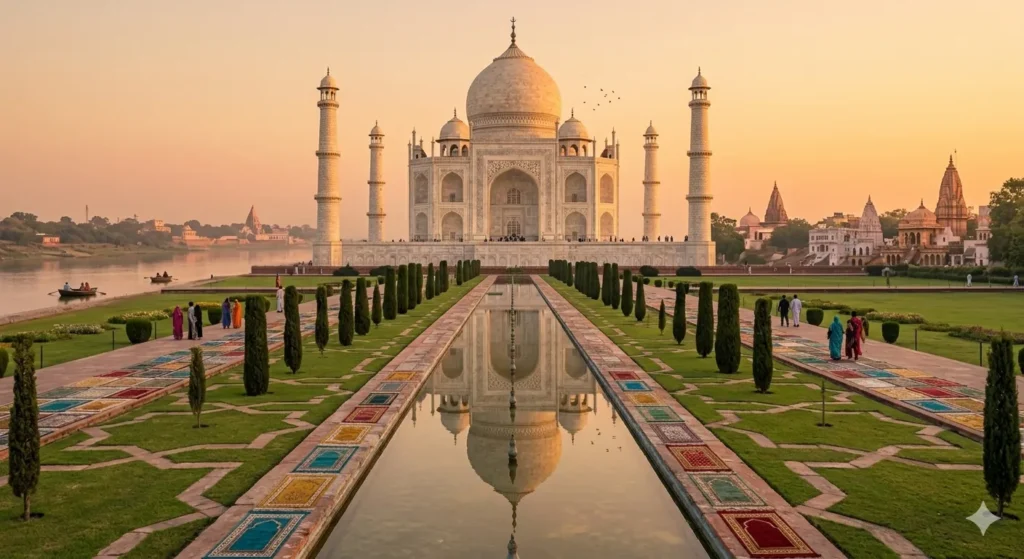
The central structure sits on a 6-metre-high marble plinth. The main dome rises 73 metres. Four minarets at the corners lean slightly outward, deliberately designed so that in an earthquake, they would fall away from the mausoleum rather than onto it. This structural decision, made 400 years ago without modern engineering, has protected the main structure through multiple seismic events.
The exterior surface decoration is the work that most visitors get wrong, they look at it from 50 metres and see white marble with geometric patterns. Get close. The ‘patterns’ are pietra dura inlay, 28 types of semi-precious stone (lapis lazuli from Afghanistan, carnelian from Arabia, turquoise from Tibet, jade from China) individually cut and set into white marble by craftsmen who had no equivalent in the world. The flowers in the inlay panels are life-size and botanically accurate to the plants they depict.
The calligraphy framing the main entrance arch is Quranic verses chosen by the calligrapher Amanat Khan, who signed his work at the base of the arch, one of the very few artisans recorded by name in the Taj’s construction. The letters increase in size as they ascend so that from ground level they appear perfectly uniform. This optical correction, applied throughout the complex, is one of the reasons the Taj Mahal looks ‘right’ regardless of the angle you approach from.
The Inner Chamber
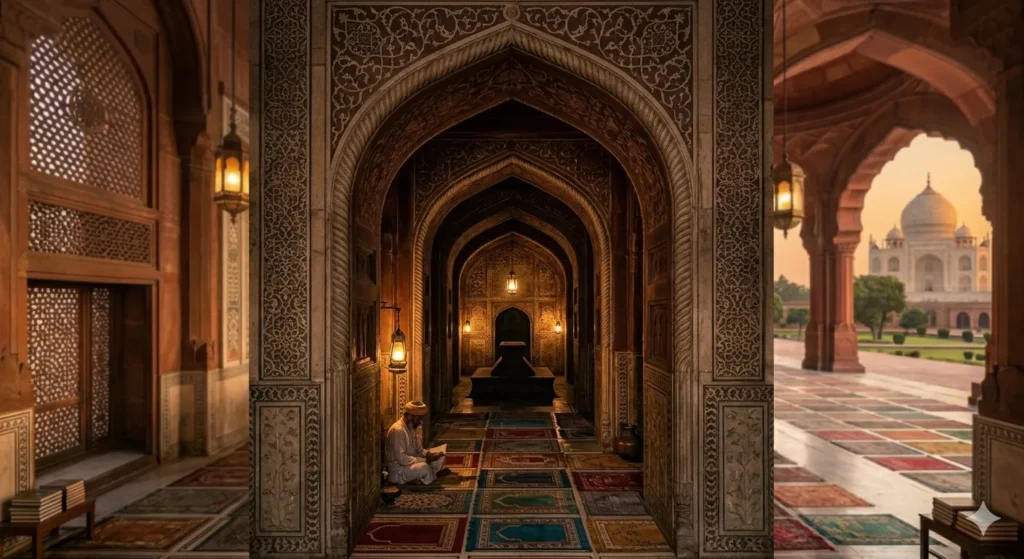
The inner chamber is accessed through the arched alcoves of the mausoleum exterior (entry ₹200, paid at the plinth). Remove shoes at the base, shoe covers are provided free.
Inside: an octagonal marble screen (jali) surrounds the two decorative cenotaphs. Below, in the crypt that is not open to visitors, are the actual graves.
The inlay work on the cenotaphs and screen is the most concentrated in the complex, individual stones the size of a fingernail, each set with visible precision. Mumtaz Mahal’s cenotaph is at the centre, marked with a writing tablet (symbol of femininity in Mughal tradition). Shah Jahan’s is to the left — slightly off-axis, the only departure from the complex’s perfect symmetry, because he was never supposed to be here.
The reverberation in the domed chamber, almost 28 seconds, is demonstrated by guides with a single note. In the silence before the other tourists arrive, the echo alone is worth the ₹200.
The Mosque and the Guesthouse
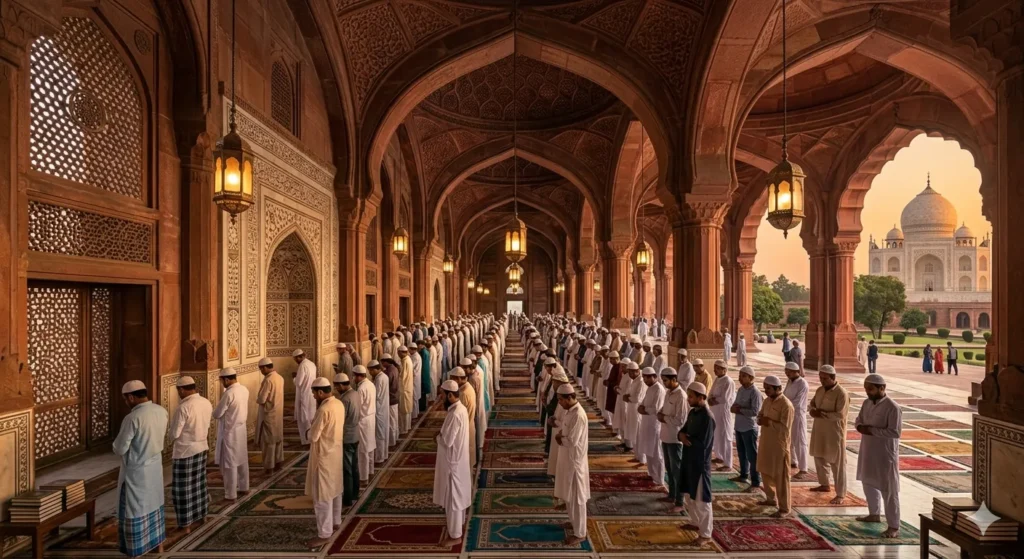
On either side of the mausoleum plinth are two identical red sandstone buildings.
The mosque, to the left (facing Mecca), is a functioning place of worship, which is why the Taj Mahal is closed on Fridays for the prayer service.
The Mihman Khana (guesthouse) to the right is architecturally identical to the mosque but has no religious function. It was built solely to maintain the complex’s perfect symmetry. This decision, to build a complete mirror image of a mosque purely for visual balance, says something about the Mughal concept of beauty that most visitors walk past without noticing.
Mehtab Bagh: The View Nobody Knows About
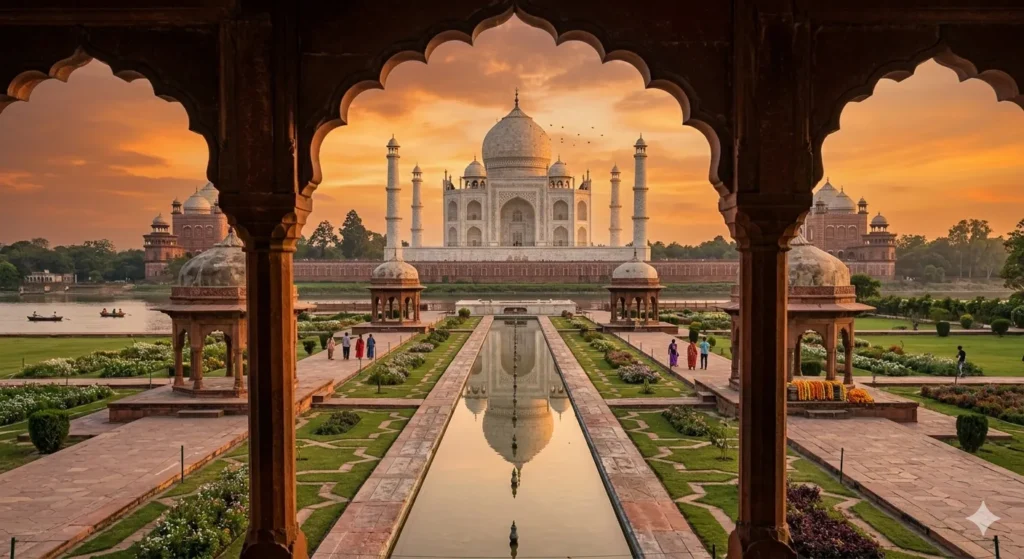
Cross the river.
Mehtab Bagh is a garden on the Yamuna’s north bank, directly opposite the Taj, a short auto-rickshaw ride from the South Gate (₹200). Entry is ₹300. Almost no one goes there.
From the octagonal pool at the garden’s edge, the Taj Mahal is across the water, catching the late afternoon sun on its north face. The river is in the foreground. There are no other tourists. The marble goes through gold and amber and then deep orange as the sun drops.
This is the view Shah Jahan planned for his own black marble tomb, the position from which his monument would have looked across at Mumtaz’s. He never built it. But the view exists, and it’s one of the most beautiful in Agra.
The Best Photography Spots
The reflecting pool axis is the famous one, standing on the central axis of the garden with the pool between you and the mausoleum. This is the photograph that exists in millions of versions. In the first hour of daylight, with the pool still and the light right, it earns its reputation.
The corner plinth positions give a completely different perspective, standing at one of the four corners of the mausoleum plinth, with a minaret in the foreground and the dome at an angle. Less photographed, more architectural.
The arched alcoves of the main entrance frame the interior of the dome and the cenotaph, dark, moody, geometric, nothing like the bright exterior shots.
And Mehtab Bagh, across the river, for the north-face view with the water and the garden in the frame.
For photography in general: whatever camera you have is worth bringing. A modern smartphone at 30 metres in good morning light produces excellent images. A telephoto lens (200mm+) allows compositions from the garden gate that compress the depth and make the monument fill the frame. No flash anywhere, no tripod without a special permit (available from the ASI office), and no drone, the airspace above the Taj is a strict no-fly zone.
How to Get to Agra from Delhi
The Gatimaan Express is the answer.
Delhi Hazrat Nizamuddin to Agra Cantt, departure 8:10am, arrival 9:50am. 90 minutes, 160 km/h, breakfast served on board, air-conditioned and comfortable. Fare: ₹750 for CC Chair Car. Book on the IRCTC app or website. Runs daily except Friday.
The Shatabdi Express is the alternative, 2 hours, slightly slower but multiple daily departures. Also reliable.
By road: the Yamuna Expressway covers the 200km in about 3 to 3.5 hours by private car. If your itinerary includes stops at Fatehpur Sikri and Agra Fort on the same day as the Taj, a private car gives the flexibility that a train doesn’t.
An important rule: no petrol or diesel vehicles are permitted within 500 metres of the Taj Mahal’s entry gates. From wherever you park or drop off, you walk, take a battery-powered auto-rickshaw (₹40–80), or hire a cycle rickshaw to the gates.
Rules and Restrictions
No food or drink inside (sealed water bottles are fine). No tobacco. No selfie stick (banned since 2018). No tripod without an ASI photography permit. No drone.
Shoes must be removed before stepping onto the marble plinth, paper shoe covers are provided free at the plinth base. Carry shoes that slip on and off easily.
Dress modestly for entry to the inner chamber, shoulders covered, knees covered. A scarf or shawl handles this in one piece and is worth carrying.
The Taj is closed on Fridays for the mosque prayer service. Check this before booking any Agra transport.
The Agra Day: What to Do Beyond the Taj
Agra has three UNESCO World Heritage Sites. Most visitors see one.
Agra Fort (2km from the Taj, same day, entry ₹650 foreign) is the Red Fort of the Mughals, Shah Jahan’s palace before it became his prison. The Musamman Burj tower where he spent his last years, looking at the Taj across the river, is the most important room in the fort. Stand there. Look at the monument. Think about what that view meant to him.
Fatehpur Sikri (40km southwest, 45-minute drive) is Akbar’s ghost capital, entire Mughal court complex built in 1571, abandoned in 1586, and preserved in red sandstone exactly as it was left. The Buland Darwaza gateway is 54 metres, the largest entrance gate in the world. Two hours here with a guide transforms the understanding of what the Mughal empire actually was.
Itmad-ud-Daulah’s Tomb (across the Yamuna, 6km from the Taj) is called the ‘Baby Taj’, built in 1628, it’s the first Mughal structure to use pietra dura inlay on its entire exterior. Smaller than the Taj, more intimate, and almost always uncrowded.
Also Read: India Itinerary 15 Days: A Complete 2-Week Trip Plan for First-Time Visitors
Frequently Asked Questions about Taj Mahal visitor guide
Is the Taj Mahal overrated?
No.
This is the considered view of almost everyone who visits with proper timing and a minimum of context. The Taj Mahal is one of those monuments, there are perhaps a dozen in the world, where the actual experience consistently exceeds what photographs and descriptions prepare you for.
The visitors who feel disappointed almost always visited at midday, without a guide, without understanding the story. Visit at sunrise with a licensed guide who knows the architectural details, and return the following day’s answer to ‘was it worth it’ is universally yes.
Is a guide necessary?
Not legally. But practically: yes.
The calligraphy that increases in size as it ascends so it appears uniform from below. The minarets that lean outward to fall away from the mausoleum in an earthquake. The 28 types of stone in the inlay work, each sourced from a different country or region. Shah Jahan’s cenotaph placed off-axis because he never intended to be here. These details exist in the monument. A guide reveals them. Without one, you see extraordinary marble. With one, you understand an extraordinary civilisation.
Hire licensed ASI guides only, from the official guide booth at the South Gate. Fixed rate approximately ₹1,200 for 2 hours. Do not hire from touts who approach at the gate entrance.
What’s the full moon night visit like?
Completely different from the daytime experience.
The ASI permits full moon viewing during the five nights around each full moon, except during Ramadan. Tickets are issued for 8pm to midnight in 2-hour sessions of 50 people each (400 visitors maximum per night). The visit is shorter than a daytime visit, the viewing is from a fixed platform rather than free movement through the complex, and the moonlit white marble in the silence of night is, by the account of almost everyone who has done it, the most beautiful thing they’ve ever seen.
Tickets open approximately 30 days before the full moon night and sell out immediately. Check the ASI portal (asi.payumoney.com) and be ready.
What is the best month to visit the Taj Mahal?
October and February are the two standout months. October: the post-monsoon air is clean and clear, the marble photographs at its most vivid, and the post-monsoon green around Agra gives the surroundings a freshness that January’s winter dust doesn’t have. February: ideal temperatures (18–26°C), excellent light quality, the spring clarity that comes from weeks of clean dry weather.
December is excellent but peak season, expect crowds and premium prices. May is hot but the dawn visit is completely manageable (28°C at 6am, rising fast) and the crowds are a fraction of December’s.
How much time do I need at the Taj Mahal?
A minimum of 2 hours for a meaningful visit, garden, mausoleum exterior, inner chamber, mosque and guesthouse, and a walk to the plinth corners. Three hours allows the kind of unhurried engagement that the complex rewards. With a guide, 2.5 hours is comfortable.
If you’re adding Mehtab Bagh, add 1 more hour and an auto-rickshaw ride across the river.
Can I visit the Taj Mahal in the summer?
Yes. The sunrise visit works in any season.
The gates open at 6am year-round (30 minutes before sunrise). At that hour in May, the temperature is around 28 degrees and rising fast. You have a reliable 90-minute window before the heat becomes uncomfortable. The monument at 6am in May has fewer than 300 visitors. The marble in the May morning light, warm and golden, is genuinely beautiful.
Avoid midday visits in April, May, and June. Everything else is manageable.
Planning Your Agra Visit
WishToGo’s North India packages all include the Agra sunrise visit as the itinerary’s headline experience. Every package includes a licensed guide, pre-booked online tickets (no queue), private transfer from your previous city, and a vetted hotel in Tajganj within walking distance of the South Gate.
Our Golden Triangle package (Delhi–Agra–Jaipur, 5 days from ₹28,000 per person) is the most popular starting point. Write to hello@wishtogo.in with your dates and we’ll send a proposal within 24 hours.