
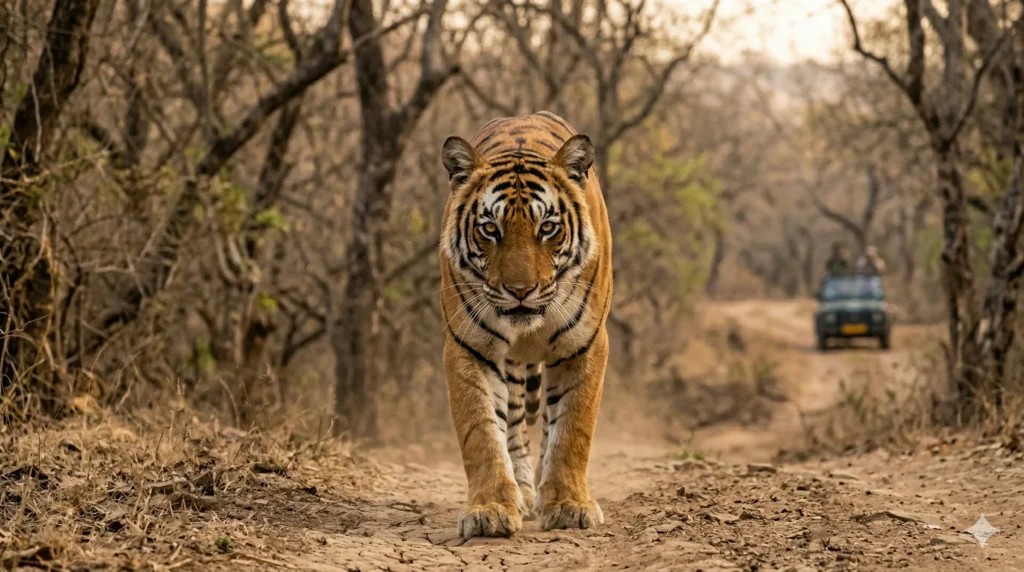
The best experience of tiger safari India is usually in Ranthambore or Bandhavgarh between April and May, when tigers gather around waterholes and sightings are most frequent. Booking 2–3 safaris and choosing the right zones significantly increases your chances of seeing a tiger.
In 1973, India had fewer than 1,800 wild tigers left.
The decline had been so rapid, from 40,000 at the start of the 20th century, decimated by colonial hunting, habitat loss, and poaching, that extinction seemed like a genuine possibility.
Then Project Tiger launched. Nine reserves. A protection framework. A commitment that has since been called one of conservation’s great reversals.
Today, India has more than 3,600 wild tigers, over 70% of the world’s entire tiger population. A number that would have seemed impossible in 1973.
Seeing one of them, in the wild, in a landscape where they have always lived, is one of the most extraordinary experiences available anywhere on earth. This guide explains how to make it happen.
Which Reserve Should You Choose?
India has 54 Project Tiger reserves. Most travelers should focus on a handful that consistently deliver the best experiences.
| Reserve | State | Tiger Pop. | Peak Months | Famous For |
| Ranthambore | Rajasthan | 75+ | April–May (lake sightings) | Tigers at fort ruins and lake, the most photographic setting in India |
| Bandhavgarh | Madhya Pradesh | 135+ | April–May | Highest tiger density in India, most reliable sightings |
| Kanha | Madhya Pradesh | 100+ | March–May | Open meadows, barasingha deer, inspired Kipling’s Jungle Book |
| Pench | MP / Maharashtra | 80+ | March–May | Mixed teak-bamboo forest, leopards, wild dog packs |
| Tadoba | Maharashtra | 100+ | March–June | Best from Mumbai, open terrain, extraordinary April–May rates |
| Jim Corbett | Uttarakhand | 260+ | February–May | India’s oldest park, Ramganga reservoir, 600+ bird species |
| Kaziranga | Assam | 120+ | February–March | One-horned rhinos, elephant safaris, different ecosystem entirely |
| Sundarbans | West Bengal | 100+ | November–February | World’s only swimming tigers, mangrove forest, boat safari |
A note on how to read this table: ‘tiger population’ is useful context, but it doesn’t directly translate to sighting probability. A small reserve with high density and open terrain (like Tadoba) often produces better sightings than a large reserve where the forest is thick and the tigers have more places to hide. The ‘famous for’ column is the more useful planning tool.
The Most Important Thing Nobody Tells You
Timing matters more than which reserve you choose.
April and May are when you want to be on safari. Not because the reserves are different, the same tigers, the same forest. But because the summer heat does something specific to animal behavior.
As the temperature climbs and water sources dry up, animals converge on the lakes and waterholes that remain. Tigers, whose normal behavior involves wide-ranging movement through dense forest, start spending significant time at predictable locations. They cool in the shallows. They rest in the open near water. They become visible in ways they aren’t in November or February.
At Ranthambore’s Rajbagh Lake in April, or at Tadoba’s main lake in May, it is not unusual to see a tiger sitting in the water in full view for 30 minutes. This is the kind of sighting that produces the photographs you’ve seen.
Yes, it’s hot. Safari mornings start at 5:30am. By noon you’re back at the lodge.
But if seeing a tiger is genuinely on your list, not just hoping for one, but actually seeing one, April and May give you the best odds. A wildlife photographer who has covered both seasons will tell you the same thing.
October to March is comfortable and reliable. April–May is when the sightings become exceptional. If your schedule allows any flexibility toward the warmer months, use it.
Ranthambore: The One That Started It All
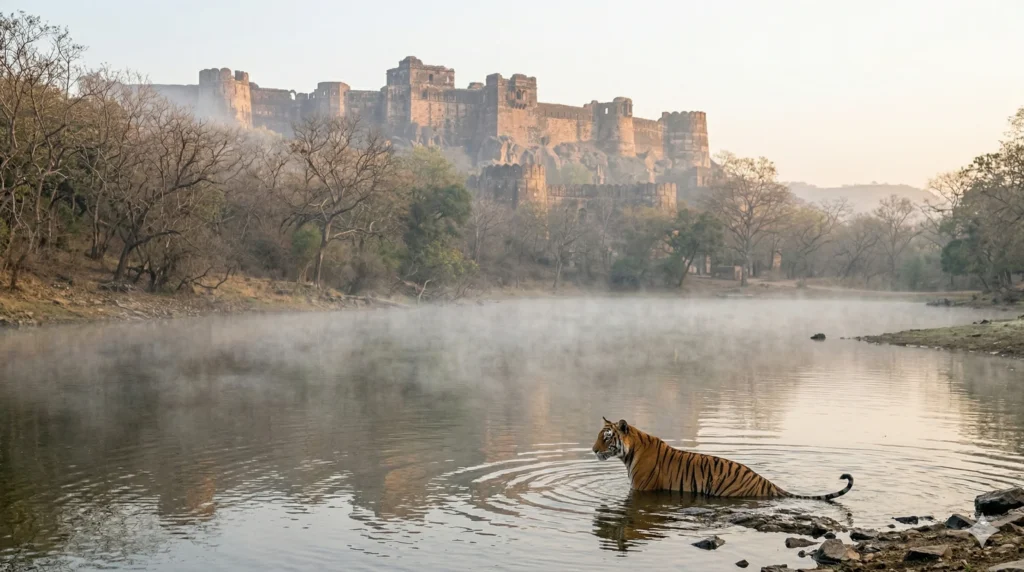
Ranthambore has a quality that the other reserves don’t.
The 10th-century Ranthambore Fort, a UNESCO World Heritage Site, rises from the forest at the centre of the reserve, and tigers have been photographed resting at its ruins, walking its perimeter, and drinking from the lakes that formed when the Chambal River dammed around the fort centuries ago. That combination, ancient monument, dense forest, lake system, tigers who have known only protection for three generations, gives Ranthambore a visual character that exists nowhere else in wildlife.
The tigers here are also unusually comfortable around safari vehicles. Decades of safe coexistence have produced animals that assess a Gypsy with mild curiosity rather than alarm, which means sightings are close, unhurried, and photographic in a way that dense-forest reserves can’t always match.
The park has 10 zones. Zones 3 and 4, covering the lake system, are the most productive and the most competitive to book. The online booking portal (at rajasthan.wildlife.in) opens 90 days ahead. The best zones for April and May sell out within an hour of the window opening, sometimes within minutes. Put it in your calendar now.
What to request: Zone 3 or 4, morning safari. Zone 2 (Padam Talao area) is a good alternative if 3 and 4 are gone. The afternoon safari in any zone is less reliable but still very worthwhile.
Also Read: Rajasthan Travel Guide: The Complete Handbook for India’s Royal Desert State
Bandhavgarh: The Numbers Don’t Lie
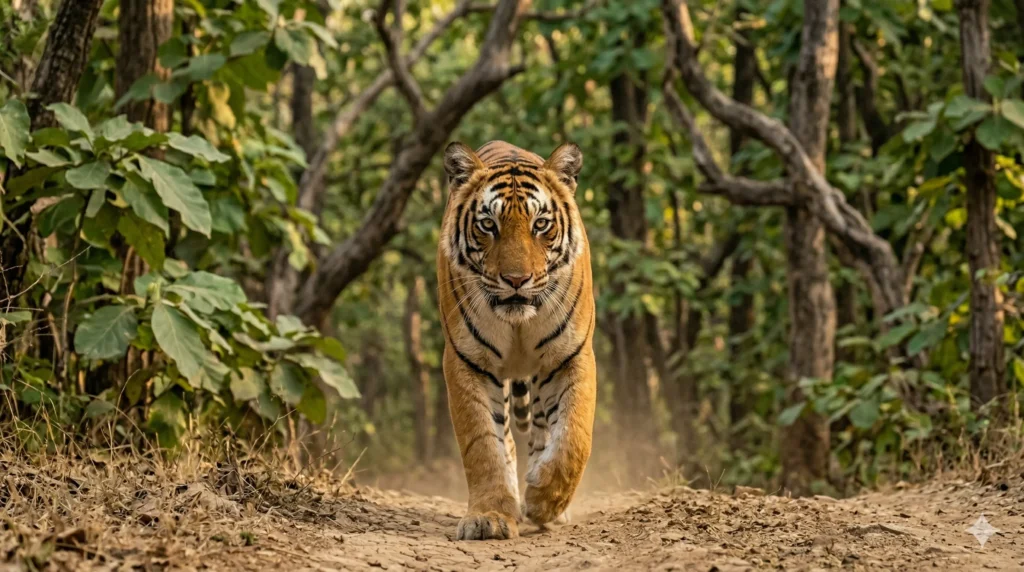
If Ranthambore is the most famous, Bandhavgarh has the strongest case for being the most productive.
India’s highest tiger density, approximately 1 tiger per 10 square kilometres in the core zone. An experienced guide at Bandhavgarh will tell you, honestly, that they see tigers on 9 out of 10 morning safaris in April and May. That number doesn’t apply to every park.
The landscape is different from Ranthambore, rocky sal forest rather than open terrain, and the fort that gives the park its name (Bandhavgarh means ‘fort of brothers’) is accessible as a viewpoint rather than a backdrop. The forest floor in April and May, when the deciduous trees have shed their leaves, has exceptional visibility. The tigers aren’t hidden by the vegetation. They’re walking through a sun-dappled open forest that photographs like a National Geographic cover.
The Tala zone is the most productive and the most competitive to book. The Chakradhara meadow within Tala is specifically famous for open-grass tiger sightings. The Magdhi and Khitauli zones are less competitive and still very good.
Book through the Madhya Pradesh Forest Department’s online system (forest.mponline.gov.in). The same 90-day window applies. The same urgency.
Kanha: The One That Inspired Kipling
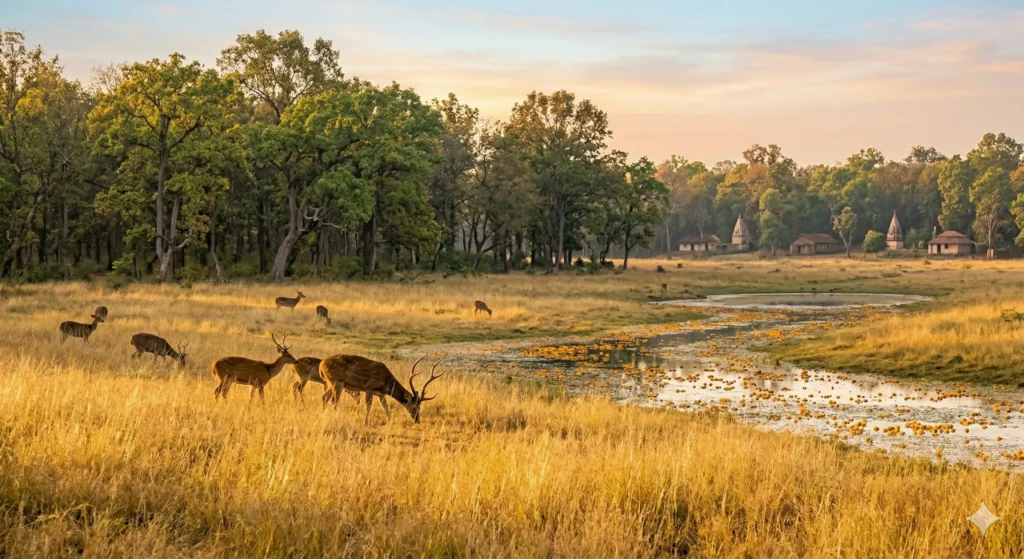
Rudyard Kipling set The Jungle Book in the forests of Central India, and the forest he imagined was probably something like Kanha.
Standing in the Kanha meadow system at dawn, the golden grass, the barasingha (swamp deer) that were brought back from near-extinction by the park’s protection, the sal forest at the edge of the clearing, and somewhere ahead in the bamboo a tiger, the fictional world feels entirely plausible.
Kanha is also where you find India’s best wildlife guides. Many of them have 20-plus years of reading this specific forest, and the difference between a good guide and an average one in a place like this is the difference between a sighting and a missed opportunity. A Kanha guide doesn’t just drive, they track. They listen to the alarm calls of spotted deer (the sound that means a tiger is moving nearby), read the pugmarks in the dust, and position the vehicle ahead of where the tiger is heading rather than behind where it was.
Four zones: Kanha, Kisli, Mukki, and Sarhi. The Kanha zone is most productive for the meadow system and the barasingha. Book through mpforest.gov.in.
Tadoba: The One Closest to Mumbai
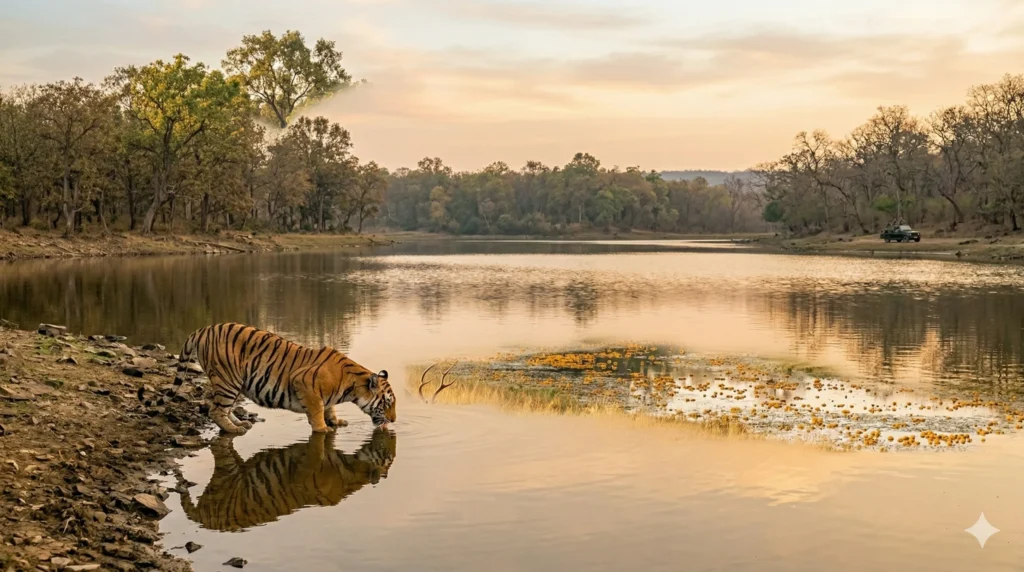
For travelers based in or visiting Mumbai, Tadoba Andhari Tiger Reserve in Maharashtra changes the safari calculus significantly.
Six hours by road from Mumbai (or one hour to Nagpur and two hours by road), Tadoba is India’s fastest-growing wildlife destination for good reason: open terrain, tigers that are highly habituated to vehicles, and a lake system at the core zone that concentrates wildlife visibly in the summer months.
The sighting rates in April and May are among the best in India. Some guides report tiger sightings on every morning safari during the peak summer weeks. The open terrain means that when you find a tiger, you see it properly, not a shadow in the bamboo, but an animal in full view across a sunlit clearing.
The core zone is open October to June; buffer zones are open year-round. Book through the Maharashtra Forest Department system (mahaforest.gov.in). The zones closest to the Tadoba Lake, Moharli and Kolara gates, are the most productive.
How a Safari Day Actually Works
Understanding the structure of a safari day helps you get more from it.
The Morning Safari (Most Important)
Gates open between 5:30am and 6:30am depending on the season and park. You’re in your Gypsy (open 6-seater vehicle) by that time, already in the forest. The morning is when animal activity peaks, the light is good, the temperature is manageable, and the forest is at its most awake.
Your guide and driver will spend the first hour reading the forest. This isn’t driving around hoping to get lucky. They’re following information: a fresh pugmark in the dust, deer alarm calls from a particular direction, a langur monkey scattering from a tree, a sambar deer giving its distinctive bark. The guide processes these signals and builds a picture of where a tiger moved last night and where it probably is now.
When you find one, when the tiger steps onto the track or stands at the water’s edge, the quality of silence in the vehicle is its own experience. Stay seated. Don’t stand. Don’t speak above a whisper. No flash photography, ever. And give the sighting time. The instinct is to photograph frantically and move on. The better approach is to watch, understand what the animal is doing, and let the photographs come from observation rather than panic.
The Afternoon Safari
Less productive but still worthwhile, especially in the summer months when tigers return to the waterholes in the late afternoon heat. Start time is 2:30pm to 3pm in winter, 3pm to 3:30pm in summer. The afternoon light is good for photography. The exit from the park is 6pm sharp.
How Many Safaris Do You Need?
Two safaris minimum to have a meaningful wildlife experience. Three to four gives you a significantly higher probability of a tiger sighting. At good reserves in April–May, three morning safaris is very likely to include at least one tiger encounter. But wildlife is wild, no guide, no operator, no algorithm can guarantee a sighting.
The other wildlife is extraordinary even on a tiger-free safari. Spotted deer by the thousand. Sambar, nilgai, wild boar, jackals. Sloth bears at the right reserves. Wild dogs (dholes) in Kanha and Tadoba. Hundreds of bird species. India’s forests are not empty on the days the tiger doesn’t appear.
Gypsy vs Canter: Choose the Gypsy
Every safari zone in India offers two vehicle types: the Gypsy (open 6-seater jeep) and the Canter (larger vehicle carrying 20 passengers).
Choose the Gypsy. Every time.
The Canter is cheaper per person but compromises the experience significantly, it’s noisier, less maneuverable, and cannot approach sightings as closely as the Gypsy. When a tiger is on the track, the Gypsy can stop 10 metres away. The Canter often can’t get close enough for the same encounter. For photography, the difference is dramatic.
Gypsy bookings at premium zones and peak months go fast, often within minutes of the 90-day window opening. If the public booking system shows your preferred zone as sold out, a good tour operator with pre-allocated quotas can often secure spots that aren’t publicly visible.
How to Book a Tiger Safari
Each state runs its own forest department booking system:
Rajasthan (Ranthambore): rajasthan.wildlife.in
Madhya Pradesh (Kanha, Bandhavgarh, Pench): forest.mponline.gov.in
Maharashtra (Tadoba): mahaforest.gov.in
Uttarakhand (Jim Corbett): corbettonline.uk.gov.in
All systems open 90 days ahead. All require registration with a phone number and ID. The peak zones (Ranthambore Zone 3–4, Bandhavgarh Tala, Kanha core) for April and May are genuinely competitive, set calendar reminders and be online at the opening minute.
The alternative is booking through a specialist tour operator. WishToGo maintains relationships with park-certified jeep operators who hold pre-allocated safari quotas, which means access to zones and dates that show as sold out on the public portal. For a packaged wildlife tour including accommodation, all safaris, transfers, and a naturalist guide, this is often the most efficient approach.
What to Pack for a Safari
Earth tones throughout, khaki, olive, brown, forest green. No bright colours, no white. Camouflage is unnecessary.
Long sleeves and long trousers for sun and insect protection. A light fleece for pre-dawn mornings, even in April, a 5:30am safari start in open forest is cold for the first hour. Closed-toe shoes or boots.
For photography: whatever you have is worth bringing. A modern smartphone at 30 metres in good light produces excellent results. A 100–400mm zoom lens on a DSLR produces magazine-quality images. Bring extra batteries, cold mornings drain them fast. A beanbag for vehicle stabilisation works better than a monopod in a moving Gypsy.
No flash. Not once. Not for any reason.
Frequently Asked Questions about Tiger Safari India
Is there a guarantee of seeing a tiger?
No. Wildlife is wild. No honest operator or guide will guarantee a sighting.
But probability matters. At Ranthambore Zone 3–4 or Bandhavgarh Tala in April and May, experienced guides report sighting rates of 85 to 95 percent on any given morning safari. Over three safaris at these locations in peak months, the probability of at least one tiger encounter is very high.
Plan for the forest, not just the tiger. If you go expecting to be rewarded by the landscape, the birds, the other mammals, and occasionally the tiger, rather than going expecting the tiger as a guaranteed product, you’ll have a better trip regardless of what the forest delivers.
How much does a tiger safari cost?
The Gypsy vehicle (6 passengers) costs ₹4,000 to 7,000 per vehicle per safari at most major reserves, meaning ₹700 to 1,200 per person when shared. Add park entry fees (₹1,500 to 3,000 for foreign visitors at most parks) and the guide charge.
The accommodation is the larger variable. Budget lodges near park gates start at ₹3,000 per night. Premium wildlife lodges, Taj Safaris’ Banjaar Tola at Kanha, Mahua Kothi at Bandhavgarh, run ₹35,000 to 70,000 per night including safaris and all meals. A mid-range 3-night, 6-safari package near Ranthambore or Bandhavgarh costs approximately ₹30,000 to 55,000 per person.
Are parks safe for children?
Yes, for children aged 6 and above (most parks have a minimum age requirement, verify before booking). Children must remain seated in the vehicle throughout. The safari is comfortable, the wildlife is extraordinary for curious children, and the early morning rhythm (5:30am start, breakfast back at the lodge) suits families well.
Can I combine a tiger safari with the Golden Triangle?
Yes, this is one of India’s most popular combinations. The standard route: Delhi → Jaipur (2 nights) → Ranthambore (2 nights, 4 safaris) → Agra for the Taj Mahal (1 night) → Delhi. Seven days, the Taj Mahal at sunrise, Amber Fort, and a Ranthambore tiger safari, a first India trip that covers heritage, culture, and wildlife in one connected journey. WishToGo offers this as a packaged itinerary, contact hello@wishtogo.in for details.
What other wildlife will I see besides tigers?
Far more than most people expect.
Spotted deer (chital) in herds of hundreds. Sambar deer, the large, elk-like deer whose alarm bark is the primary tiger indicator. Gaur (Indian bison) in Kanha and Pench, the world’s largest bovine, shoulder height almost 2 metres. Sloth bears at Ranthambore and Bandhavgarh. Mugger crocodiles at Ranthambore’s lakes. Wild dogs (dholes) in Kanha and Tadoba, rare, but when a pack is on a hunt it’s one of India’s most intense wildlife encounters. And the birds: crested serpent eagle, changeable hawk-eagle, Indian roller, paradise flycatcher. The list at any of these reserves runs to 300-plus species.
Is Project Tiger actually working?
Yes, and significantly.
When Project Tiger launched in 1973, the Indian tiger population was estimated at 1,827. The 2022 census counted 3,682. The model, protected core zones, buffer zones for human-wildlife coexistence, anti-poaching infrastructure, and direct revenue from wildlife tourism going to reserve management, has been studied and adapted by conservation programs globally. It’s one of the genuinely good conservation stories of the past 50 years.
Going on a tiger safari isn’t just tourism. The revenue directly funds the protection framework that has allowed this recovery to happen.
Planning Your India Wildlife Safari
WishToGo designs customised India wildlife itineraries from 2-night Ranthambore additions to Golden Triangle trips, to 21-day Madhya Pradesh circuits covering Kanha, Bandhavgarh, and Pench. All packages include pre-booked safari slots through our operator relationships, curated lodge accommodation, certified naturalist guides, and 24-hour on-ground support.
Write to hello@wishtogo.in with your travel dates, preferred reserves, and budget. We respond within 24 hours with a detailed proposal.